
Site Evaluation and Protocol
Report Details
Report Synopsis
Riverside Indoor Air Assessments - riversideiaq.example
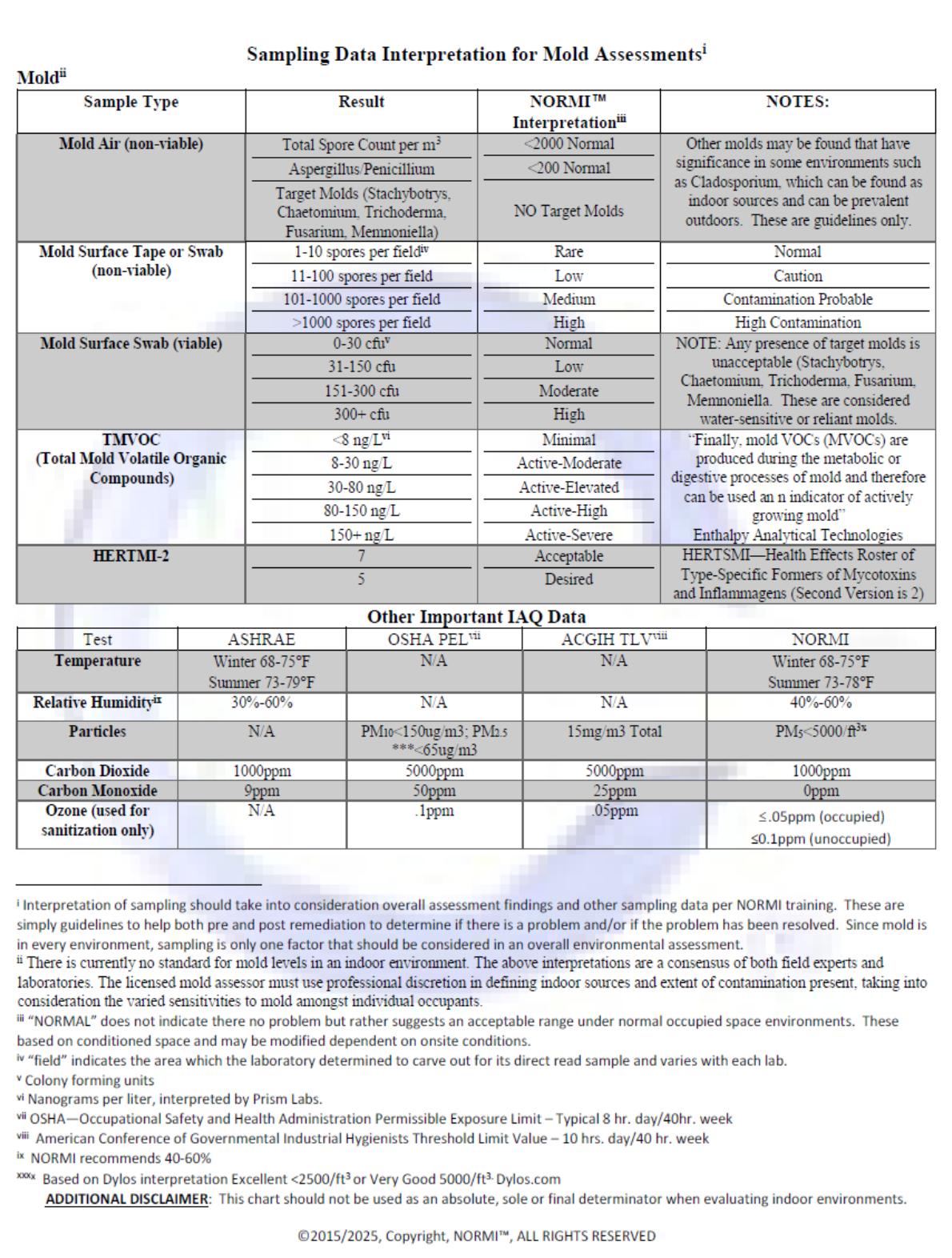
Interpreting Lab Results
In the table below I am highlighting area’s that were tested. Traditional plating methods utilize colony counting techniques to determine CFU levels. Air-O-Cell technology derives equivalent CFU values using light detection. See Sampling Data for Interpretations for Mold Assessments on following page.
| Sample # | Sample Type | Location | Results of Note |
|---|---|---|---|
| S001 | Air-O-Cell | Outdoor | Total spore count reached 2200 spores/m³ indicating significant mold presence. |
| S002 | Swab | Backdoor Below Baseboard | Elevated counts of Cladosporium and bacterial indicators (Bacillus and Pseudomonas) noted. |
Relative Humidity
Your relative humidity is very important, and should be monitored year round. It is not only possible but likely, if you allow your facility to reach humidity levels in the 60% plus range, that the air becomes the moisture source for mold spores to begin to populate in the air and on all of your surfaces and contents. The recommendation is to keep your Relative Humidity in the 40%-55% range to keep this from happening. You can purchase a meter at Lowe’s for around ten dollars to keep track of your environment. If you use a humidifier, you should be very careful and clean your machine every week, read the factory recommendations, because a humidifier can cause illness. “Google Humidifier Disease”. We determined your RH with an Omega RH820 Hydro Thermometer.
| Indoor Temp | Indoor RH | Indoor DP | Indoor PC | Outdoor Temp | Outdoor RH | Outdoor DP | Outdoor PC |
|---|---|---|---|---|---|---|---|
| 72 | 44 | 55 | — | 70 | 80 | 18 | — |
Introduction
This report summarizes the findings of the mold inspection performed on September 7, 2025. The client reported symptoms including coughing and bloody nose. The inspection was prompted after the replacement of the HVAC unit, an event that appears linked with the onset of indoor air quality issues. Several lab reports and photo documentation were provided as part of the investigation.
Findings
Environmental Readings
- Indoor Temperature: 72°F, Relative Humidity: 44%, Dew Point: 55°F, Particle Count: 8
- Outdoor Temperature: 70°F, Relative Humidity: 80%, Dew Point: 18°F, Particle Count: 7
- Basement readings were not available.
Generally, indoor mold spore counts should be lower than outdoor readings. In this case, indoor particle counts are only slightly above the outdoor baseline which may indicate an amplification event due to the HVAC replacement and subsequent disturbance of previously contaminated materials.
Visual & Photo Documentation
Photos uploaded by the inspector were noted with comments as ‘see images’. Although specific descriptions were not provided, these images likely document areas of potential water intrusion and visible mold evidence. It is advised that the photo documentation be reviewed in detail to correlate with lab and swab findings.
Laboratory Confirmation & Analysis
- Symptoms Report: The 'Brennan Taylor Symptoms.pdf' report details occupant symptoms including respiratory distress, chest tightness, and neurological effects. The onset of these symptoms coincided with the HVAC replacement, suggesting mobilization of contaminants within the duct system.
- Mold Spore Analysis: The 'Brennan Taylor Mold Labs.pdf' indicates various spore types from samples taken in multiple home locations (e.g., kitchen, master bathroom, and behind baseboards). The indoor spore levels of common genera (such as Aspergillus/Penicillium, Cladosporium, and Alternaria) when compared with outdoor values are indicative of an amplified event.
- Actinomycete and Bacterial Assessments:
- The 'Brennan Taylor Actino Score.pdf' shows elevated actinomycete levels which are often linked with water-damaged environments.
- The 'Brennan Taylor HERTSMI Lab.pdf' and 'Brennan Taylor Actino Index.pdf' further document significant elevations in specific bacterial and actinomycete species, with values suggesting that human-associated mold (and bacterial) contamination is present. These indices provide a measure of both the water damage history and the potential for chronic inflammatory responses (CIRS) among sensitive occupants.
Risk Assessment & Health Concerns
- Elevated actinomycete and bacterial loads are associated with inflammatory responses and have been correlated with symptoms such as respiratory distress and systemic effects, as reported by the client.
- Exposure to the identified mold species (including Aspergillus, Penicillium, and Stachybotrys) presents a risk of allergenic reactions, especially in immuno-compromised individuals.
- The HVAC unit replacement appears to have mobilized previously settled contaminants, leading to amplified indoor spore counts, despite counts being borderline within expected indoor/outdoor comparisons.
Containment and Operational Plan
Immediate Response
- Review photo documentation to identify all visibly affected areas including those near HVAC components and water entry points.
- Establish containment zones in areas where lab results and photos indicate amplification of mold and bacterial loads.
- Temporarily shut down or isolate the HVAC unit until ductwork and associated components are thoroughly cleaned and remediated.
Source Removal
- Remove water-damaged materials and contaminated ductwork components.
- Dispose of affected insulation, drywall, or other construction materials that show evidence of mold growth.
- Conduct thorough cleaning using HEPA filtration and EPA-registered antimicrobials throughout the contaminated areas.
Cleaning & Post-Remediation Verification
- Implement multi-stage HEPA vacuuming and wet wiping of surfaces to ensure all residual spores and bacterial debris are removed.
- Perform post-remediation air sampling to confirm that indoor spore counts are lower than or equivalent to outdoor baseline levels.
- Swab and/or use qPCR testing in previously contaminated areas to verify the absence of pathogenic species such as Stachybotrys and high actinomycete levels.
Occupant Safety & Recommendations
- Advise sensitive occupants (those with asthma, immunological sensitivities, or preexisting respiratory conditions) to avoid contaminated zones until clearance testing confirms safe air quality.
- Maintain containment until verified remediation and clearance are complete.
- Implement ongoing monitoring of indoor air quality post-remediation to prevent recurrence.
Summary and Next Steps
The combination of clinical symptoms, lab reports, and the potential for amplified mold contamination due to the recent HVAC unit replacement indicate a need for immediate remediation. The remediation plan should focus on comprehensive cleaning, removal of contaminated building materials, and thorough post-remediation verification to ensure that indoor spore counts are at or below outdoor baseline levels.
Kitchen sampling location
Master bathroom sampling location
Back door below baseboard
HVAC equipment area
Potential water entry point
Laboratory/Diagnostic Results
Attached find copies of lab results conducted by us on your indoor air quality. There are five different types of testing we could have performed and it is our responsibility to use our experience and expertise to assess which testing procedures will give us the best IAQ/Mold Profile of your indoor environment. Should additional testing be required, we may select one or more of these methods to enhance our understanding of your environment so we will have an objective overview of your indoor air quality. The air test is performed using an Zefon IAQ Lite International Bio Pump plus Serial # 17470 calibrated on February 18th 2025. The air flow calibrator BPIL-302 Serial # B-28609 was also calibrated on 02/18/2025. This is a negative air flow pump that draws air across the Air-O-Cell cassette, which is then sent to the lab, and the slide is removed from the cassette and put under a microscope to determine what types of mold spores are present. Air samples are collected for a duration of 5 minutes at 15 liters per minute. Each sample is recorded on the Chain of Custody form that accompanies your samples to Hayes Microbial Consulting in Midlothian Virginia. The five methods from which we choose are:
- Air-O-Cell Sampling—in this process we collect particulate from the air to get a comparison count between the indoor air and the outdoor air. This method does not evaluate the viability of the spores collected.
- Impaction sampling—this process uses gravity or pressure to plate a Petri dish with airborne particulate and then incubate for the laboratory to identify. This method only represents a small sample of the entire indoor air environment.
- Environ-SWAB Sampling—this is an effective way of collecting “dust” which includes viable mold spores, plate them to a Petri dish, and have the laboratory identify and count the number of live colony forming units (cfu). This method recognizes only the viable mold that has settled out in the location where it has been collected.
- Environ-TAPE sampling—where visible mold is present, this tape lift method allows the laboratory to identify and count the number of dead or live colony forming units (cfu). This method does not recognize viability of mold growth only the presence of mold.
- Bulk Sampling—occasionally we determine that specific construction materials or other items require laboratory testing to identify and count the number of either dead or live colony forming units (cfu). This method does not recognize viability of mold growth only the presence of mold.
NORMI™ Certified IAQ/Mold Inspector and Assessor (CMI/CMA)
Certified Mold Assessor
Certified Mold Remediator
Certified Residential Thermographer (CRT)
NORMI™ Certified Indoor Environmental Assessor (CIEA)
Moisture Meter Readings
Moisture Meter readings can add to your understanding of the indoor environment. The moisture meter we use is a Protimeter Surveymaster which is a Dual-Function meter designed to recognize moisture content of construction materials that have been tested. This meter can read moisture with non-penetrating and penetrating probes. This meter also has deep penetrating probes that can test the interior of a wall cavity. The general rule of thumb in our industry is that moisture content in construction materials in excess of 17% MAY indicate a moisture problem. Since we are often unable to test in wall cavities, attics, or other non-visible locations, we can only draw limited conclusions about the moisture of any area tested. These conclusions, however, are included in our over-all assessment and evaluation of the IAQ/Mold Profile in your environment.
No significant moisture issues were recorded during the inspection.Footnote:
ISO 14644 - 13:2017 is an international cleanroom standard that specifies methods for cleaning surfaces to achieve defined levels of cleanliness, both for microscopic particles and chemical residues. Originally developed for industries like pharmaceuticals, aerospace, and microelectronics — where even trace contamination can cause harm — its cleaning principles are applied here to whole - building biotoxin remediation to ensure the highest achievable environmental cleanliness.
ISO: International Organization for Standardization
14644: The set of standards specifically for clean rooms and controlled environments
Part 13 (2017 edition): Cleaning of surfaces to achieve defined levels of cleanliness in terms of particle and chemical classifications
ISO 14644 - 13:2017 provides methods and best practices for cleaning surfaces in cleanrooms so they meet specific cleanliness requirements — both in terms of particles (like dust, debris, microbes) and chemical residues. It covers:
- Cleaning techniques (wiping, vacuuming, mopping)
- Sequence and direction of cleaning (cleanest to dirtiest, top to bottom)
- Approved equipment and materials
Verification methods (particle counts, surface residue testing)
It's most often applied in pharmaceutical manufacturing, semiconductor production, biotechnology labs, aerospace assembly, and other environments where even tiny contaminants can cause major problems.
Limitations:
- The mold/biotoxin inspection is not a warranty, guarantee, or insurance policy.
- The mold/biotoxin inspection is not technically exhaustive.
- The mold/biotoxin inspection will not identify concealed or latent conditions or defects.
- The mold/biotoxin inspection will not identify mold growth not readily visible at the time of the inspection.
- The mold/ biotoxin inspection does not include future conditions or events.
NORMI™ Certified IAQ/Mold Inspector and Assessor (CMI/CMA)
Certified Mold Assessor
Certified Mold Remediator
Certified Residential Thermographer (CRT)
NORMI™ Certified Indoor Environmental Assessor (CIEA)